
Corporate Governance
“The system by which companies are directed and controlled in the interest of shareholders and other stakeholders”
It is a process of administering a company like a monarchial state which installs its own customs, laws, and policies from the highest to the lowest levels.
Corporate governance essentially involves balancing the interests of a company’s many stakeholders, such as shareholders, senior management executives, customers, suppliers, financiers, the government, and the community.
Corporate governance need arises because those that manage the business (Agents) do not own that business but manage the business on behalf of those who own it (Principal).
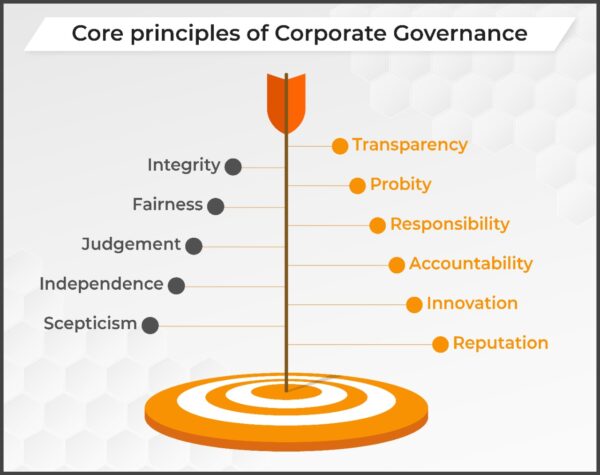
Public Sector Governance
Public sector organizations are, in some way, connected to, or deliver, public goods and services. This means that they help to, in some way, deliver goods and services that cannot be, or should not be, provided by ‘for profit’ businesses.
Each public sector organisation must be strategically effective in that it must achieve the objectives established for it in carrying out government policy. Because they are funded by public money, they must also be efficient and make the most of whatever resources they are provided with.
The governance in the public sector will be maintained by having an Oversight body and reporting to that body.
Typical (and general) roles of oversight bodies include the following, although their roles do vary substantially depending on jurisdiction and government policy.
Roles of Oversight Body
1) Compliance with govt rules and policies.
2) Ensure organization is well run & meets performance targets
3) Monitoring the performance and compare with the budget
4) Appointing or removing senior management
5) Regular reporting to higher authorities
What is agency theory
Agency theory is a group of concepts describing the nature of the agency relationship deriving from the separation between ownership and control.
By accepting to undertake a task on their behalf, an agent becomes accountable to the principal by whom they are employed. The agent is accountable to that principal.
Directors (agents) have a fiduciary responsibility to the shareholders (principal) of their organisation (usually described through company law as ‘operating in the best interests of the shareholders’).
The cost of agency relationships
Agency Cost:
Agency costs arise largely from principals monitoring activities of agents, and may be viewed in monetary terms, resources consumed or time taken in monitoring.
Residual Cost:
This is an additional type of agency cost and relates to directors furnishing themselves with expensive cars and planes etc. These costs are above and beyond the remuneration package.
Stakeholder theory
The basis for stakeholder theory is that companies are so large and their impact on society so pervasive that they should discharge accountability to many more sectors of society than solely their shareholders.
Considering and applying the stakeholder theory business will have direct positive impact through improved customer perception, employee motivation, supplier stability, shareholder conscience investment.