Integrated Reporting brings together material information about an organisation’s strategy, governance, performance and prospects in a way that reflects the commercial, social and environmental context within which it operates. It leads to a clear and concise articulation of your value creation story which is useful and relevant to all stakeholders.
But is not only about reporting; Integrated Reporting encompasses Integrated Thinking. It is as much about how companies do business and how they create value over the short, medium and long term as it is about how this value story is reported.
The concept is saying that if we just consider the financial capital and its value creation then it’s not a good practice and here we are avoiding effects on other stakeholders, society and environment.
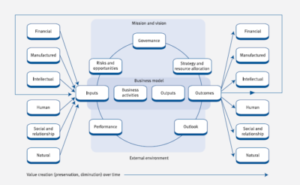
So, Integrated reporting identified have suggested six types of capital which company should consider and should create the value for maximum relevant capitals in short, medium and longer term.
1) Financial Capital
2) Manufactured Capital (P&M)
3) Human Capital
4) Intellectual/Intangible Capital
5) Natural Capital
6) Social Capital
At the core of the value creation process is an entity’s business model, which draws on various capitals and inputs, and by using the entity’s business activities, creates outputs (products, services, by products, waste) and outcomes (internal and external consequences for the capitals).
The value creation process is depicted below,
Guiding Principles /Characteristics of Integrated Reporting:
There are seven guiding principles that requires an organization’s reporting to display in some way in order to be seen as meaningful.
– Connectivity across all relationships that create value.
– Stakeholders’ relationship and how they work to create value.
– Materiality, disclosing those matters that sustainability affect value creation.
– Reliability and completeness, avoiding any bias.
– Conciseness (to encourage people to read about ).
– Consistent and comparable presentation with other organisations and over time.
– Strategic and forward looking.