
Supply Chain Management
A supply chain consists of all parties involved, directly or indirectly, in fulfilling a customer request.
The supply chain includes not only the manufacturer and suppliers, but also transporters, warehouses, retailers, and even customers themselves.
A supply chain is dynamic and involves the constant flow of information, product, and funds among different stages.
Even though the term supply chain may imply that only one player is involved at each stage, most supply chains are actually networks where each stage receives product from several suppliers and sends output to several customers. It may be more accurate to use the term supply network or supply web to describe the structure of most supply chains.
Managing the Chain
Active management of supply chain activities aims to maximise customer value and achieve a sustainable competitive advantage. It represents a conscious effort by the supply chain firms to develop and run supply chains in the most effective and efficient ways possible. Supply chain activities cover everything from product development, sourcing, production, and logistics, as well as the information systems needed to coordinate these activities.
Managing the chain primarily therefore concentrates on the management and progression of the following three items:
- Materials / Inventory
- Information
- Funds
Push & Pull Supply chain management
All processes in a supply chain fall into one of two categories, depending on the timing of their execution relative to end customer demand. With pull processes, execution is initiated in response to a customer order.
With push processes, execution is initiated in anticipation of customer orders based on a forecast. Pull processes may also be referred to as reactive processes because they react to customer demand. Push processes may also be referred to as speculative processes because they respond to speculated (or forecasted), rather than actual, demand.
Upstream SCM
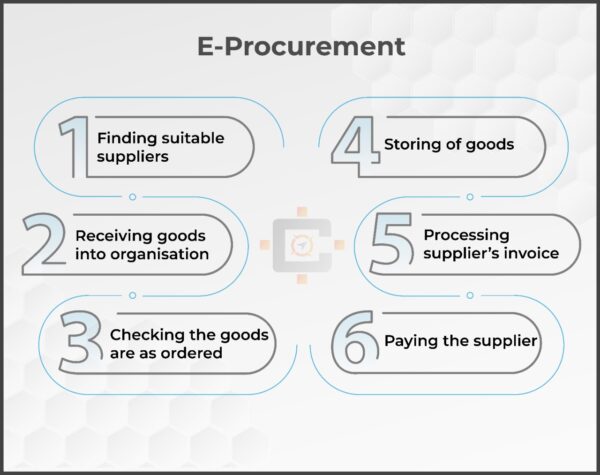
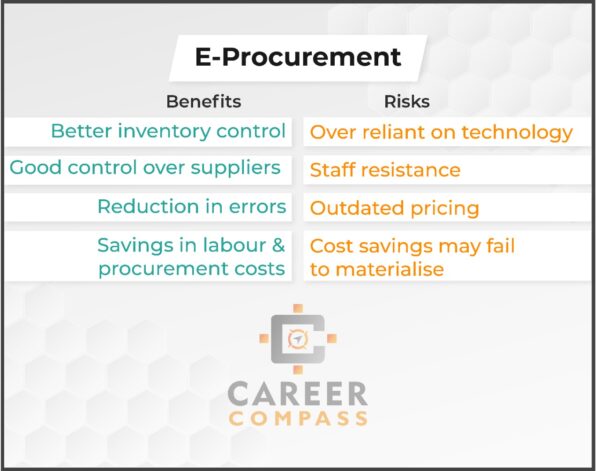
The key activity of upstream SCM is e-procurement.
What is e-procurement?
The term ‘procurement’ covers all the activities needed to obtain items from a supplier: the whole purchases cycle.
Electronic Procurement (also known as e-procurement) is the business-to business purchase and sale of supplies and services over the internet. It is a way of using the internet to make it easier, faster, and less expensive for businesses to purchase the goods and services they require.
Downstream SCM
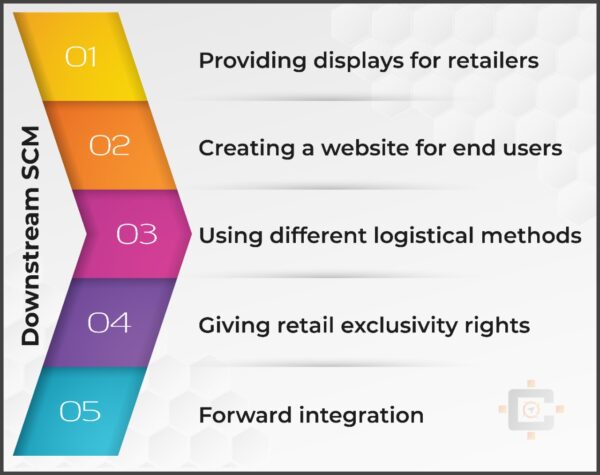
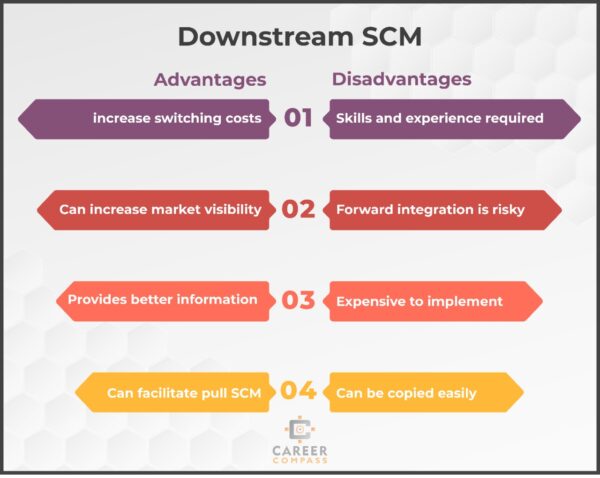
Downstream supply change management is about managing relationships with both customers and consumers, as well as any other intermediaries along the way.
Restructuring SCM
In an earlier chapter we looked at strategic choices of outsourcing, vertical integration and strategic alliances, where the key issues of cost, quality and control were highlighted.
These are still relevant for online businesses as much as for conventional ‘bricks and mortar’ organisations. All organisations must decide between:
- vertical integration – manufacturing in-house
- virtual integration – the majority of supply chain activities are undertaken by third parties
- virtual disintegration (disaggregation) – in between these two extremes.
However, internet technology allows more efficient and cheaper communications within the chosen structure and may make virtual integration preferable to vertical integration.
Disruptive Technology
Big Data
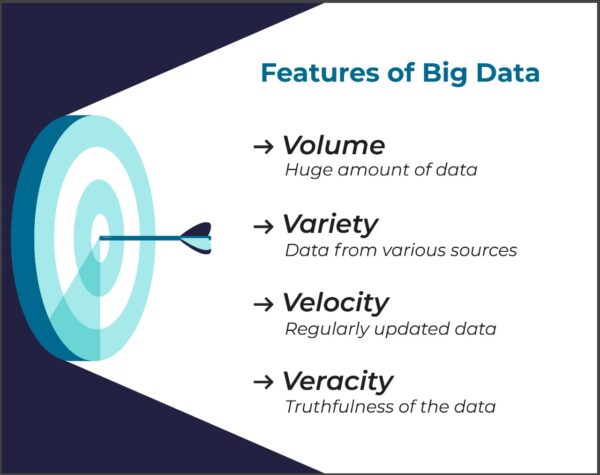
Big data is a term for a collection of data which is so large that it becomes difficult to store and process using traditional databases and data processing applications.
Cloud Computing
Cloud computing is computing based on the internet. It avoids the need for software, applications, servers and services stored on physical computers. Instead, it stores these with cloud service providers who store these things on the internet and grant access to authorised users.
Artificial Intelligence:
Artificial Intelligence is an area of computer science that emphasises the creation of intelligent machines that work and react like human beings.
Some of the activities that computers with artificial intelligence are designed for include:
- Voice recognition
- Planning
- Learning
- Problem solving
Machine learning:
Most recent advances in AI have been achieved by applying machine learning to very large data sets. Machine learning algorithms detect patterns and learn how to make predictions and recommendations by processing data and experiences, rather than by explicit programming instruction. The algorithms themselves then adapt to new data and experiences to improve their function over time.
Software solution
A key element in making IT a success is choosing the correct software. There are a number of areas to consider when buying new software:
- Establishing what we need the software to do
- Deciding between generic and bespoke solutions
- Choosing a supplier of our chosen solution
- Implementing the software solution