
Funding Strategies
As well as considering managing for value and the needs of wider stakeholders, financial decision makers must identify:
- Which SBUs need funding,
- How funding can support strategic decisions, and
- What type of funding they need.
This will allow them to create unique funding strategies for each business unit.

Standard cost card
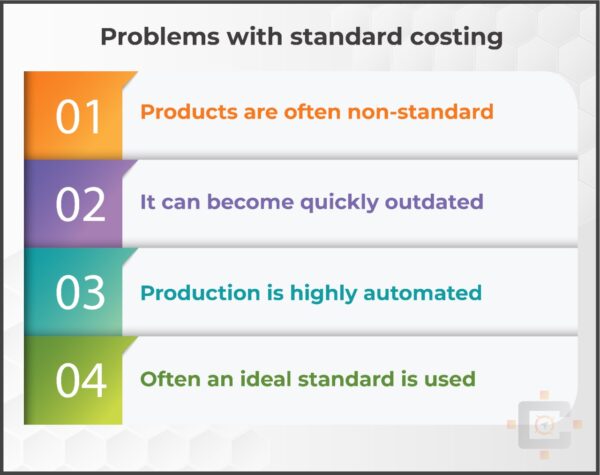
Much of cost accounting is based on the principles of standardisation. It assumes that businesses operate in a stable environment where, for example, a standard amount of materials will be used in the production of each product and that a standard price can be attached to the price of those materials.
Marginal Analysis
Marginal analysis refers to situations where we use contribution to make decisions.
The key is that only costs which vary with the decision should be included in an analysis of the decision.
Marginal analysis can be used in key areas of decision making such as:
- Accepting/rejecting special contracts
- Closing/continuation decisions.
Each of these will now be considered in turn.
Probabilities and expected values
An expected value summarises all the different possible outcomes by calculating a single weighted average. It is the long run average (mean).
The expected value is not the most likely result. It may not even be a possible result, but instead it finds the average outcome if the same event was to take place thousands of times.
Decision trees and multi-stage decision problems
A decision tree is a diagrammatic representation of a decision problem, where all possible courses of action are represented, and every possible outcome of each course of action is shown. Decision trees should be used where a problem involves a series of decisions being made and several outcomes arise during the decision-making process.
Decision trees force the decision maker to consider the logical sequence of events. A complex problem is broken down into smaller, easier-to-handle sections. The financial outcomes and probabilities are shown separately, and the decision tree is ‘rolled back’ by calculating expected values and making decisions. It is important that only relevant costs and revenues are considered, and that all cash is expressed in present value terms.
Budgeting
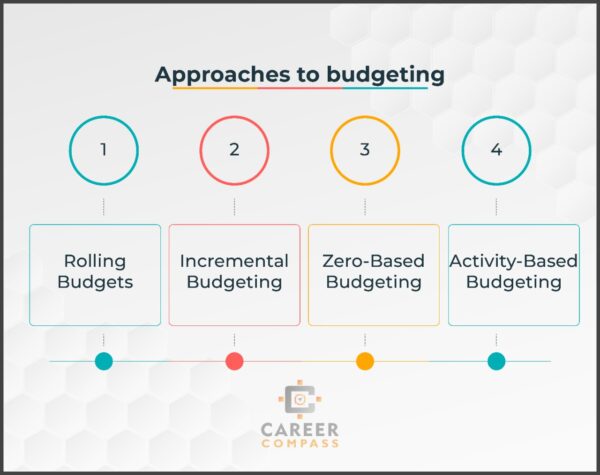
As part of ‘strategy in action’, a business will create plans for each SBU, product, function etc. These plans are often in the form of budgets. The budget sets out the short-term plans a target necessary to fulfil the longer-term strategic plans and objectives.
The budgets will also play a vital role in reviewing and controlling strategic plans. They will be used to identify and investigate variances and to highlight when a plan or process is ‘out of control’.
Budgets are distinct from forecasts. A forecast is a prediction of a future outcome. A budget is a plan (usually in financial terms) that looks to use and/or achieve that forecast.

Variance analysis
An effective part of budgetary control is to calculate and investigate variances from the budget.
Variance investigation:
Variances arise naturally in standard costing because a standard cost is a long-term average cost. In any period, actual costs may be higher or lower than standard but in the long run these should cancel out if the process is under control.
Variances may also arise because of:
- poor budgeting
- poor recording of cost
- operational reasons
- random factors.
Not-for-profit organisations
Organisations such as charities and trade unions are not run to make profits, but to benefit prescribed groups of people.
Financial objectives of ‘not-for-profit’ organisations:
Since the services provided are limited primarily by the funds available, their financial aim is:
- to raise the maximum possible sum each year (net of fund-raising expenses)
- to spend this sum as effectively as possible on the target group (with the minimum of administration costs).