Institutional Investors
An institutional investor is a company or organization that invests money on behalf of other people. Mutual funds, pensions, and insurance companies are examples.
Fund managers and other professionals working for the institutions have the skills and expertise to contribute towards the direction and management of a company.
But here are some problems given with the Institutional investors.
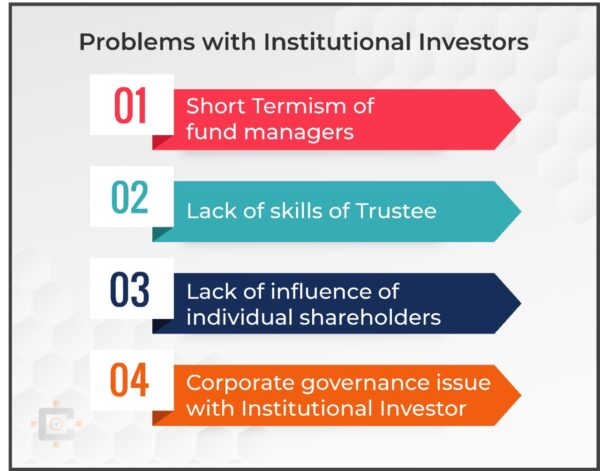
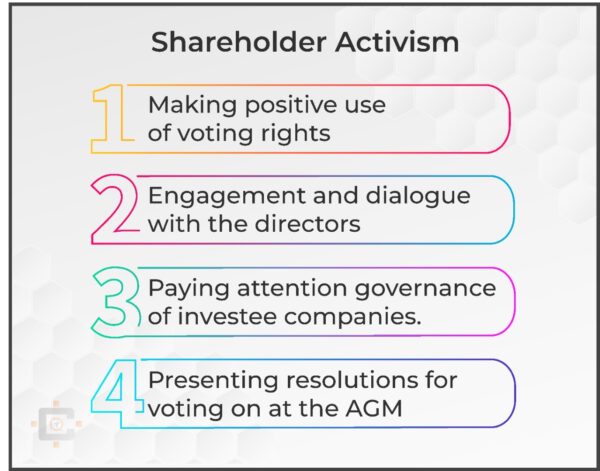
Institutional Investor can not only work as an trader, they have to play an active role and have to represent as an shareholder activist on behalf of all small investors.
General Meetings
There are two types of meetings in the company.
Annual General Meeting:
It is an annual meeting to be held compulsory. Several ordinary and special resolution is passed on this meeting. Audited financial statements are being considered and dividend will be declared for shareholders.
Extraordinary General Meeting:
If any issue arises in the company that requires the participation of entire shareholders and company can’t wait till next AGM, then Extraordinary General Meeting will be held. The purpose of the meeting should be communicated in advance.
Disclosure
Shareholders are true owner of the company and so they are entitled to have maximum information about the company.
Apart from the legally required disclosure company can communicate information voluntarily.
Below things are usually communicated voluntarily through annual report.
- CEO or Chairman’s statement
- Risk disclodure
- Governance
- Social and environmental reporting
- Other
Sustainability
Sustainability focuses on meeting the needs of the present without compromising the ability of future generations to meet their needs. The concept of sustainability is composed of three pillars: economic, environmental, and social—also known informally as profits, planet, and people.
Effects of Economic Activity
Economic activity is only sustainable where its impact on society and the environment is also sustainable.
Environmental Footprint:
The environmental footprint is an attempt to evaluate the size of a company’s impact on the environment in two respects:
– The company’s resource consumption.
– Any harm to the environment brought about by pollution emissions.
A measurement of the resource consumption and pollution emissions in terms of harm to the environment in either qualitative, quantitative or replacement terms.
Social Footprint
Social footprint is a measure of the impact or effect that an entity can have on a given set of concern or stakeholder interests.
It is the impact on people, society and the wellbeing of the communities. Impact can be positive (Such as job creation and community benefits) or negative, such as when a plant closure increases unemployment and the local community suffers.
Social & Environmental Reporting
Social Accounting:
It is a concept describing the communication of social and environmental effects of a company’s economic action to stakeholders.
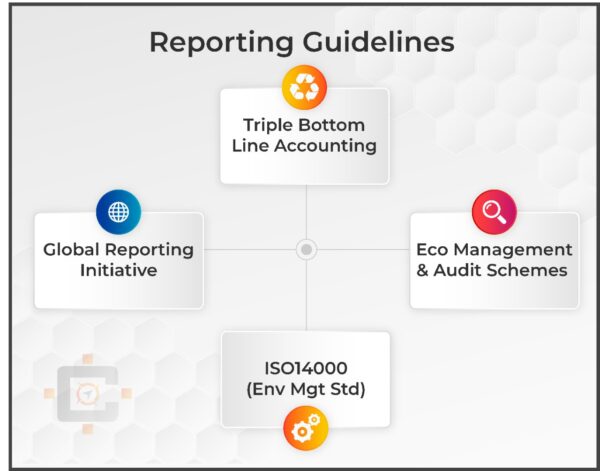
Triple Bottom Line accounting is one of the better way for social accounting.
Environmental Accounting:
Environmental accounting relates to the need to establish and maintain systems for assessing the organisation’s impact on the environment.
EMAS and ISO 14000 are both systems that support the establishment and maintenance of environmental accounting systems.
Social & Environmental Audit
A process that enables an organisation to assess and demonstrate its social, economic, and environmental benefits and limitations.
Below are some elements of Social Audit:
- Statement of purpose
- Obtain the view of external stakeholders.
- Obtain views of the board of directors, staff and volunteers to assess satisfactory ways of working.
- The social audit team manages the social audit and measures performance ready for input into next year’s social audit.
Integrated Reporting
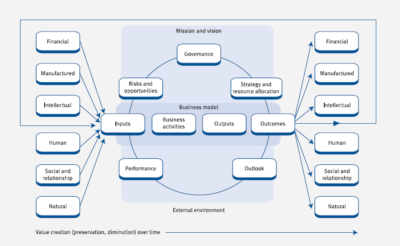
Integrated Reporting encompasses Integrated Thinking. It is as much about how companies do business and how they create value over the short, medium and long term as it is about how this value story is reported.
The concept is saying that if we just consider the financial capital and its value creation then its not a good practice and here we are avoiding effects on other stakeholders, society and environment.
So Integrated reporting identified have suggested six types of capital which company should consider.
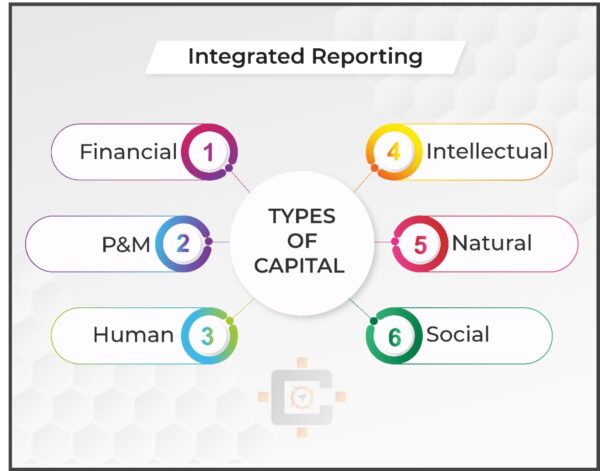
The value creation process is depicted below,